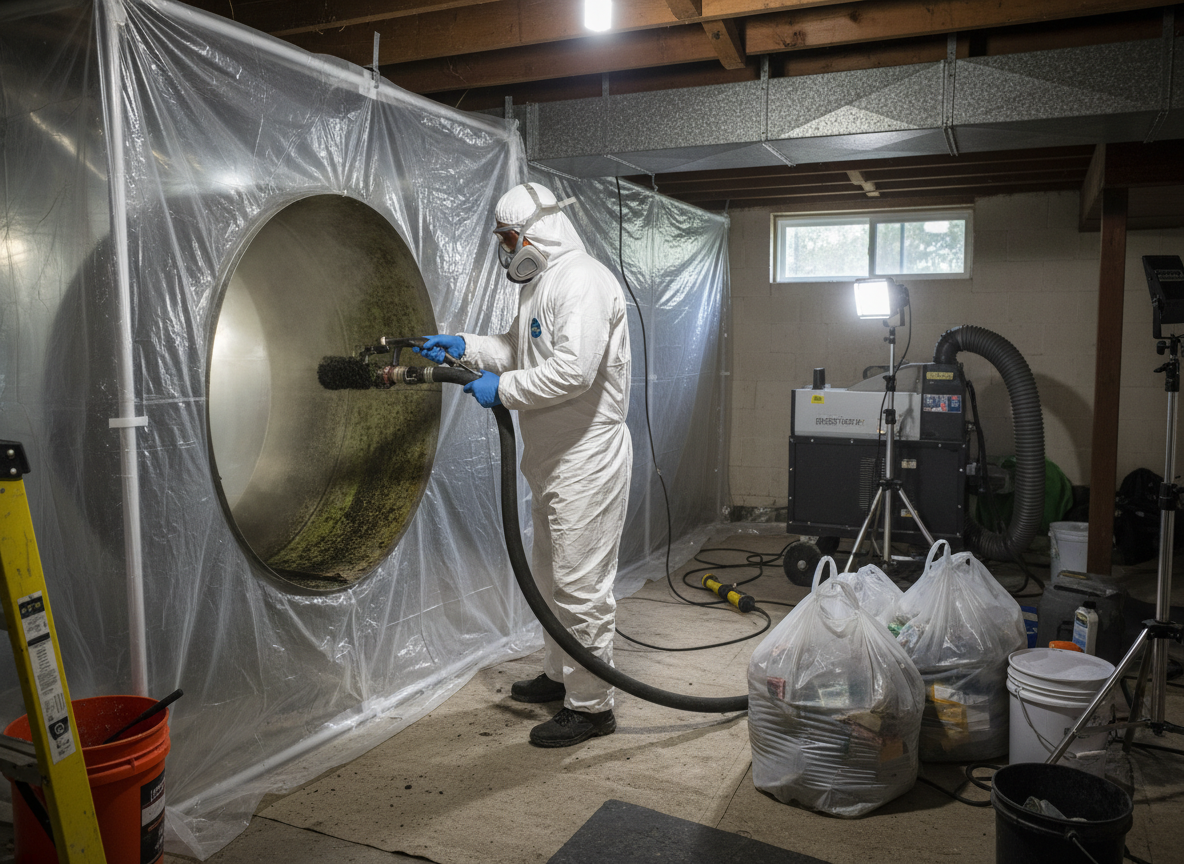
Cedar Glen sits in San Bernardino County at elevation near Lake Arrowhead, where warm summer days followed by cold winter nights create rapid temperature drops inside unconditioned ventilation runs. This drives condensation on metal ducts and attic vents, especially in the older cabin stock built before modern vapor barriers became standard. Homeowners often first notice a musty odor when the furnace kicks on in fall, because spores have already colonized the interior surfaces of the ductwork and the joist bays around the vents. Removing the growth requires isolating the affected runs, negative-air containment, and HEPA vacuuming followed by antimicrobial treatment that reaches the seams and registers without wetting insulation that cannot be easily replaced in tight mountain attics.
The terrain around Hook Creek Road adds another layer: steep driveways and limited access mean equipment must be carried in by hand, and any containment setup has to account for wind that funnels moisture through ridge vents during Santa Ana events. We map the entire supply and return paths first, because mold in a single branch line will re-contaminate the system if left untreated. In many Cedar Glen homes the original flex duct has degraded and holds hidden moisture pockets that only show up once the line is opened. After source removal we install new rigid duct sections where needed and verify airflow balance so the system does not pull additional attic air once the work is complete.
San Bernardino County building practices in these older neighborhoods often left minimal insulation at the attic plane, so winter humidity from cooking and showers migrates upward and condenses on cold vent surfaces. We always check the bathroom and kitchen exhaust terminations first, because those short runs are the most common entry points for moisture that then travels through the main trunk lines. Proper remediation includes sealing those exhaust paths and confirming that the dryer vent exits the envelope rather than terminating inside the attic, a detail missed in many pre-1980s builds around Lake Arrowhead.
Technician insight
In Cedar Glen the thing that catches most people out with ventilation mold remediation is how quickly attic vents collect condensation once winter nights drop below freezing after a warm day; older homes near Lake Arrowhead with single-pane windows and minimal ridge insulation push warm indoor air upward every evening, so the mold keeps returning unless those exhaust paths are sealed at the same time the ducts are cleaned.
Cedar Glen Attic Duct Condensation
Homeowner reported musty smell from ceiling registers after first cold snap. Inspection found black growth inside the main trunk line and at two bathroom exhaust terminations where warm air met cold metal near the ridge. We isolated the attic, removed the contaminated flex sections, sealed the exhaust paths, and reinstalled rigid duct with proper insulation wrap. Odor disappeared and no new growth appeared the following winter.
How it works
- 1
Site Assessment and Mapping
We arrive at the Cedar Glen address and trace every supply, return, and exhaust run while noting insulation gaps and condensation points created by the mountain climate.
- 2
Containment and Isolation
Negative-air machines and sealed barriers are set up around affected duct sections so spores do not migrate into living spaces during removal.
- 3
Source Removal and Cleaning
HEPA vacuuming, antimicrobial application, and replacement of degraded flex duct or insulation occur only after the system is fully isolated.
- 4
Verification and Air Balancing
Post-cleaning inspection confirms no visible growth remains and airflow is restored without pulling additional attic moisture into the home.
Pricing
Pricing varies with the number of affected runs, accessibility on steep Cedar Glen lots, and whether duct sections must be replaced.