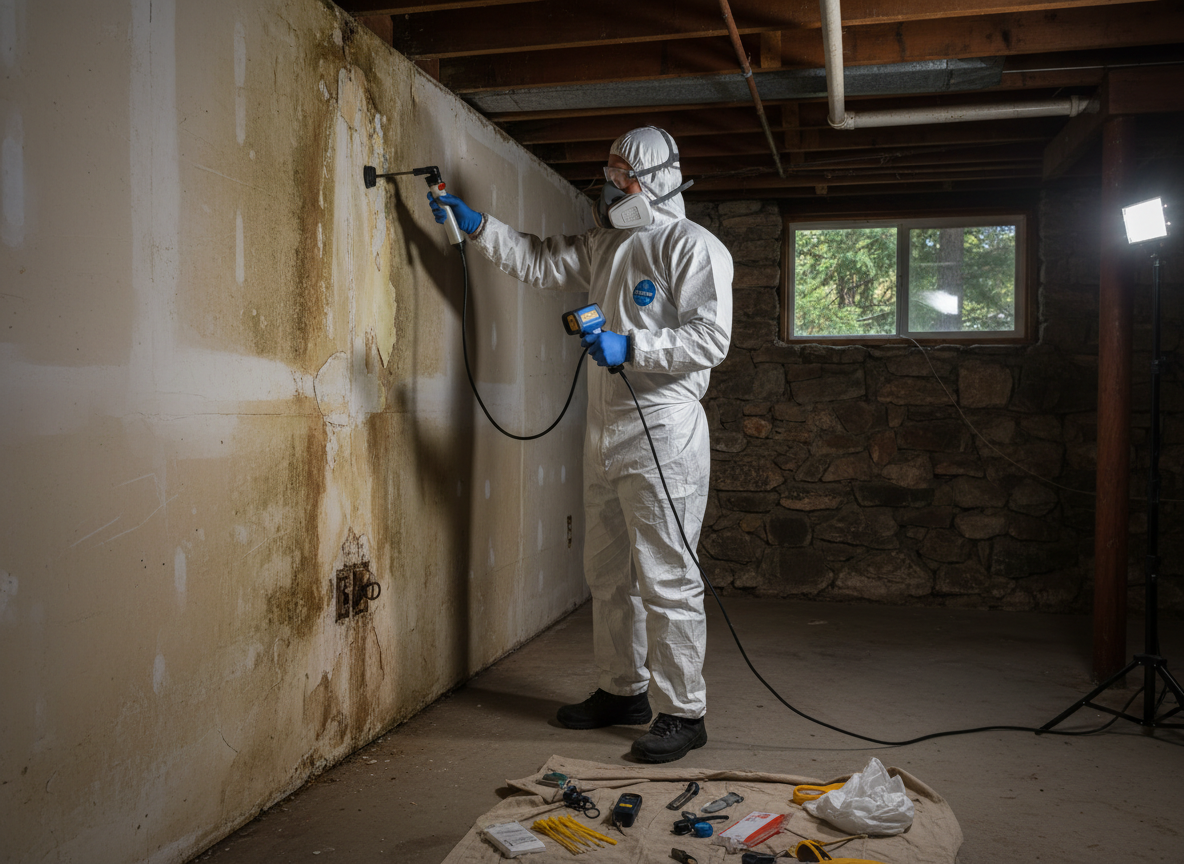
Cedar Glen sits in the San Bernardino Mountains where cold winters drive indoor condensation on single-pane windows and in poorly ventilated attics of older cabins. Warm summer days then raise humidity levels that feed mold on roof sheathing and around Lake Arrowhead shoreline homes. Testing must account for these swings because visible growth often hides behind insulation or in crawl spaces on sloped lots along Hook Creek Road.
Air sampling with spore traps and moisture meters locates hidden colonies that standard visual checks miss in homes built before modern vapor barriers became common. Surface tape lifts and bulk material samples sent to independent labs confirm species and concentration levels that affect remediation scope. Edge cases include false negatives from recent rain events diluting outdoor baselines or from HVAC systems circulating spores across multi-level properties.
San Bernardino County building practices leave many Cedar Glen structures with unsealed foundation vents and attic bypasses that channel meltwater into wall cavities. Technicians map relative humidity gradients room by room, focusing on north-facing walls and areas near wood-burning stoves where temperature differentials create persistent damp zones. Reports include chain-of-custody documentation and clear thresholds so homeowners know whether conditions require containment before any removal work begins.
Technician insight
In Cedar Glen the thing that catches most people out with Mold Testing is how cold winter nights pull moisture into uninsulated attics of homes along Hook Creek Road, then warm days push it into wall cavities near Lake Arrowhead. Homeowners often test only visible spots and miss the gradient that starts in the crawl space on the uphill side of the lot.
Condensation-Driven Growth in North-Facing Attic
A Cedar Glen homeowner noticed musty air after the first snow melt but saw no stains on ceilings. Testing revealed elevated spore counts in the attic where single-pane windows and poor ridge venting allowed condensation to soak insulation batts. Air and surface samples confirmed Penicillium growth; the report outlined targeted containment before any insulation replacement.
How it works
- 1
Site Walkthrough
Technician inspects Cedar Glen property for visible staining, musty odors, and moisture sources tied to winter snow loads or summer humidity near Lake Arrowhead.
- 2
Air and Surface Sampling
Spore trap cassettes collect indoor and outdoor air samples while tape lifts and swabs gather material from suspect surfaces in attics, crawl spaces, and wall cavities.
- 3
Moisture Mapping
Infrared camera and pin meters document relative humidity and wood moisture content throughout the home, noting locations influenced by terrain slope and lake proximity.
- 4
Lab Analysis and Report
Samples go to an accredited laboratory for species identification and concentration counts; findings return with a written summary and recommended next steps.
Pricing
Pricing varies by home size, number of samples, and access difficulty in sloped Cedar Glen terrain.