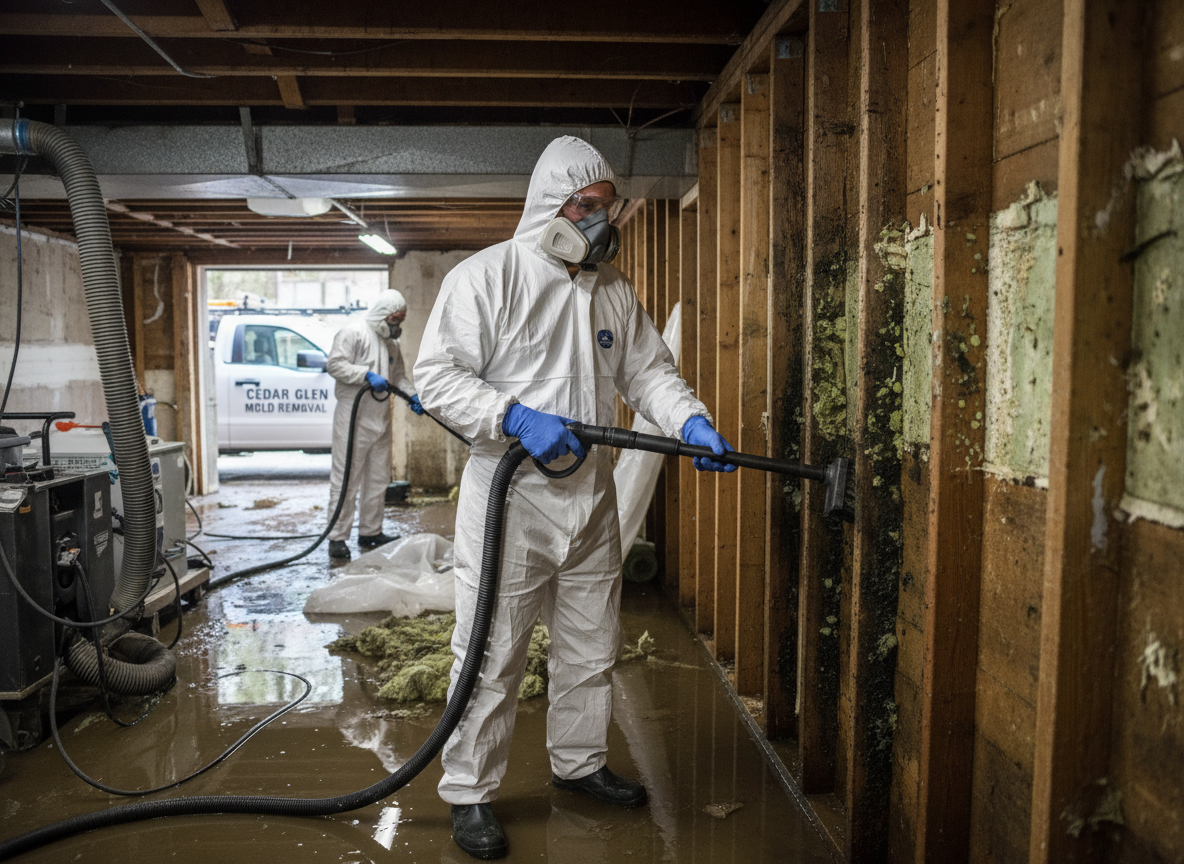
Cedar Glen sits in the San Bernardino Mountains where warm summers give way to freezing winters, driving condensation in attics and crawl spaces of older cabins built decades ago. Moisture from melting snow around Lake Arrowhead often seeps through aging rooflines and foundation vents, feeding hidden mold colonies behind knotty pine paneling and under subfloors. Professional mold removal here starts with mapping moisture gradients using thermal imaging because surface cleaning alone fails when the source is snowmelt trapped in the soil around Hook Creek properties.
San Bernardino County building practices in the 1960s and 1970s left many Cedar Glen homes with minimal vapor barriers, so winter humidity spikes turn wall cavities into mold reservoirs. Technicians must remove and dispose of contaminated insulation while protecting adjacent living spaces from spore release during demolition. The terrain's steep slopes also mean drainage around homes frequently directs water toward basements, requiring targeted drying equipment that accounts for the area's thin mountain air accelerating evaporation rates once containment is set.
Homeowners in neighborhoods surrounding Cedar Glen frequently discover mold after spring thaws when ice dams on roofs force water under shingles. A full professional mold removal job includes HEPA vacuuming of settled spores, antimicrobial treatment of framing, and post-remediation air sampling to confirm clearance before any reconstruction. Skipping these steps risks cross-contamination into HVAC systems that are common in these elevated homes, spreading spores to upper floors during the next heating cycle.
Technician insight
In Cedar Glen, the thing that catches most people out with professional mold removal is water pooling under the house from snowmelt off the steep slopes around Lake Arrowhead. Homeowners seal the obvious leaks but miss how the cold winters push condensation into the dirt floors of 1970s cabins, so the mold keeps returning until the drainage is fixed.
Hidden Growth After Winter Thaw
A Cedar Glen homeowner noticed musty odors in the living room after spring snowmelt. Inspection revealed mold under the subfloor fed by poor drainage directing water from nearby slopes. We contained the area, removed contaminated insulation, dried the joists, and improved grading to divert future runoff. Air tests cleared the space with no recurrence the following winter.
How it works
- 1
Initial Assessment
Inspect all affected areas in Cedar Glen homes using moisture meters and thermal cameras to locate hidden growth tied to winter snow melt.
- 2
Containment Setup
Seal work zones with plastic barriers and negative air machines to prevent spore spread through the open floor plans typical of mountain cabins.
- 3
Removal and Cleaning
Remove porous materials, HEPA vacuum surfaces, and apply treatments while addressing drainage issues common near Lake Arrowhead slopes.
- 4
Drying and Verification
Deploy dehumidifiers suited to thin mountain air, then conduct clearance testing before returning the space to the homeowner.
Pricing
Cost depends on square footage affected, accessibility of mountain home crawl spaces, and extent of hidden growth from seasonal moisture.