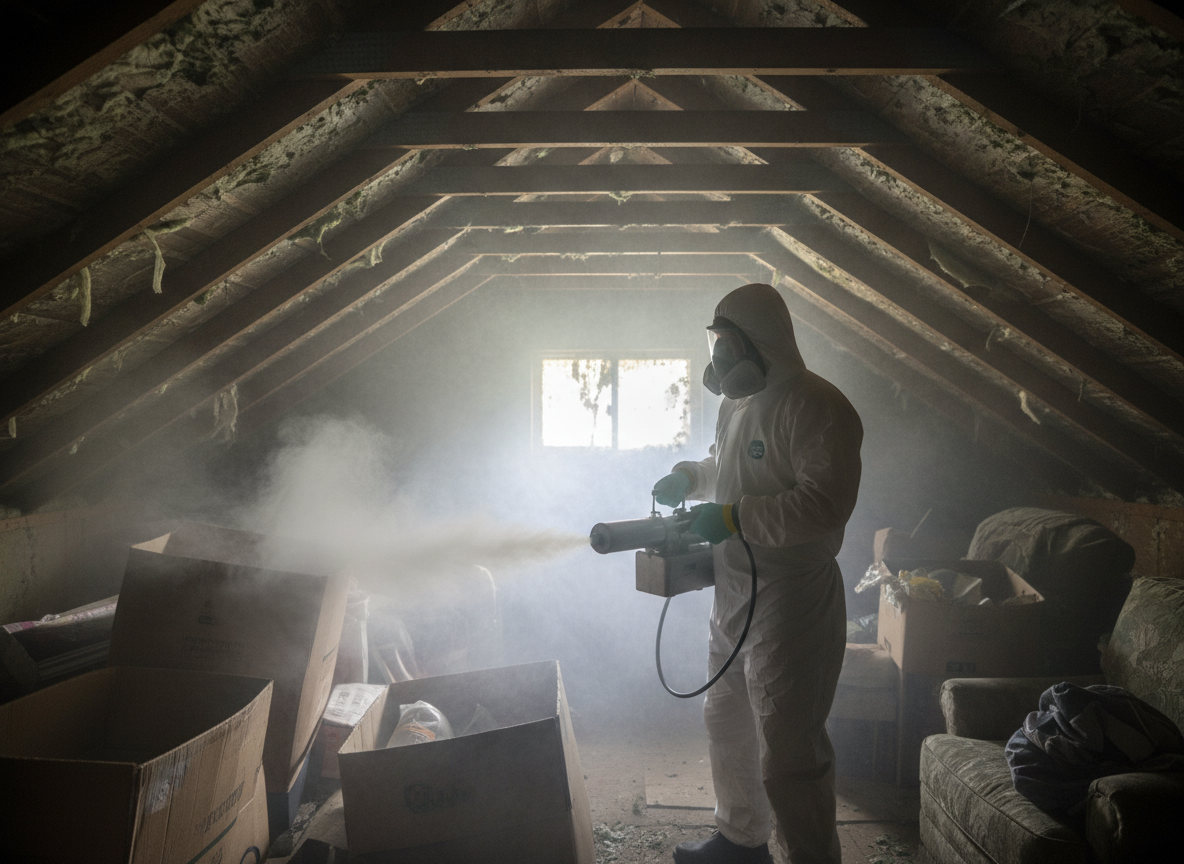
Mold fogging treatment uses a fine mist of EPA-registered antimicrobial agents dispersed through HVAC systems and enclosed spaces to contact spores that settle in wall cavities and attic insulation. In Cedar Glen, homes built decades ago along Hook Creek Road often have limited access points and unsealed ductwork that lets winter condensation collect on roof sheathing before summer warmth reactivates growth. Technicians first isolate the affected zone with plastic sheeting and negative air machines, then run the fogger for the precise dwell time required by the product label to avoid damaging wood or leaving residue that could affect pets.
The process accounts for the steep terrain around Lake Arrowhead where runoff during spring thaw can push moisture under crawlspace vapor barriers. Fogging reaches the upper joists and rim boards that liquid sprays miss, but it does not replace physical removal of heavily saturated drywall or insulation. After fogging, crews ventilate the structure for several hours while monitoring humidity levels that typically spike again once temperatures drop below freezing at night in San Bernardino County.
Homeowners in Cedar Glen sometimes attempt over-the-counter foggers without sealing returns, which simply circulates spores into living areas. Professional treatment includes post-application surface sampling to confirm spore counts have dropped below outdoor baselines before reoccupancy. Because power outages are common during winter storms, crews carry battery backup equipment to maintain negative pressure throughout the job.
Technician insight
In Cedar Glen the thing that catches most people out with mold fogging treatment is the way cold winter nights pull warm kitchen and bathroom air into uninsulated attics along Hook Creek, leaving a thin film of moisture on the underside of the roof deck that fog alone cannot fix if the insulation is already saturated.
Winter Condensation in a Cedar Glen Cabin
A homeowner near Lake Arrowhead noticed musty odors after the first hard freeze. Inspection showed condensation on attic sheathing and light growth on exposed rafters. We contained the space, ran antimicrobial fog through the HVAC and attic, then ventilated and confirmed spore levels matched outdoor readings. The family returned the next day with no recurrence after adding attic ventilation.
How it works
- 1
Containment Setup
Seal off the treatment zone with 6-mil plastic and negative air machines to prevent spore migration into occupied spaces.
- 2
HVAC Preparation
Remove filters, cover coils, and confirm all supply and return paths are open for even fog distribution.
- 3
Fog Application
Run the antimicrobial fogger through the HVAC and targeted rooms for the labeled contact time while monitoring humidity.
- 4
Ventilation and Verification
Air out the home, then take surface and air samples to confirm reduction before returning furniture and residents.
Pricing
Pricing varies by square footage treated, number of HVAC zones, and whether insulation removal is needed first; contact us for an on-site assessment.