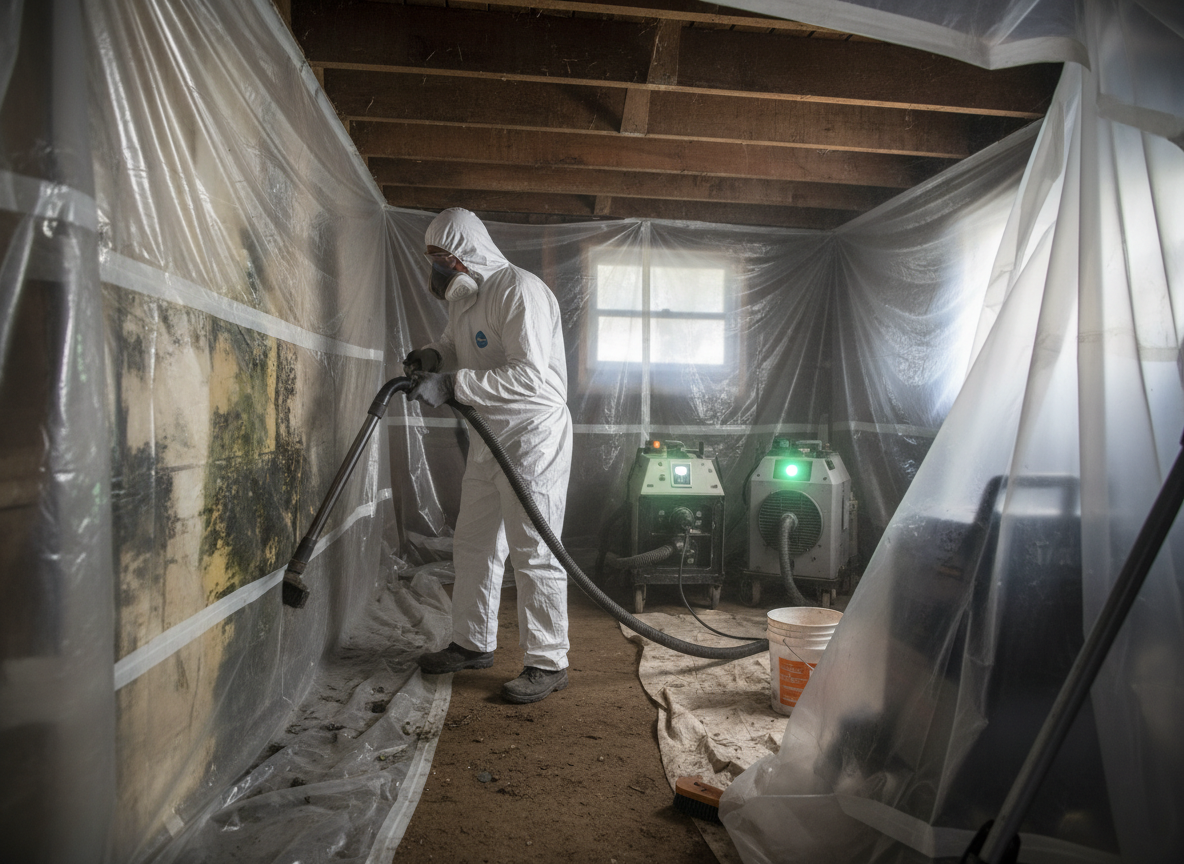
Cedar Glen sits in the San Bernardino Mountains where warm summers give way to freezing winters that drive condensation inside crawl spaces and attics of the area's many 1960s-1980s wood-frame cabins. These temperature swings combine with proximity to Lake Arrowhead to keep relative humidity elevated, allowing mold to colonize behind cedar siding, under subfloors, and in poorly vented roof cavities. Abatement crews must first isolate the affected zones with negative air machines and plastic sheeting to prevent spores from migrating into living areas while they remove saturated insulation and drywall.
Many homes here rest on sloped lots with shallow foundations that channel snowmelt and rain toward the structure. When water enters through cracked stem walls or leaking window wells, it pools against rim joists and creates hidden colonies that standard visual inspections miss. Technicians use moisture meters and borescopes to map the full extent before any demolition, then bag and remove contaminated materials following IICRC S520 protocols adapted for mountain terrain access limitations.
After physical removal, drying equipment must account for the thin mountain air that slows evaporation. Dehumidifiers sized for sea-level conditions often fall short, so crews run additional air movers and monitor readings for several days until wood moisture content drops below 12 percent. Homeowners in Cedar Glen frequently discover that simply cleaning visible spots without addressing the winter condensation source leads to rapid regrowth once temperatures drop again.
Technician insight
In Cedar Glen, the thing that catches most people out with mold abatement is how the cold winters create ice dams and attic condensation that homeowners never see until spring. The older cabins along Hook Creek Road often have single-pane windows and minimal insulation, so moisture keeps returning unless the ventilation is fixed at the same time.
Attic Growth After Winter Freeze
A Cedar Glen homeowner noticed musty odors in the upstairs bedroom once temperatures rose. Inspection revealed black growth on roof sheathing caused by ice dam leaks from the prior winter. Crews contained the attic, removed the affected insulation and sheathing sections, dried the space, and added ridge venting to prevent recurrence.
How it works
- 1
Initial Assessment
Technicians arrive at the Cedar Glen address, document visible growth, and use meters to locate hidden moisture in attics, crawl spaces, and walls influenced by cold winter air.
- 2
Containment Setup
Plastic barriers and negative air machines isolate the work zone so spores do not spread into occupied areas of the home near Lake Arrowhead.
- 3
Material Removal
Saturated drywall, insulation, and trim are cut out and bagged for disposal while crews protect unaffected surfaces from cross-contamination.
- 4
Drying and Verification
Equipment runs until moisture readings stabilize, followed by post-remediation testing to confirm the space meets clearance criteria before reconstruction begins.
Pricing
Cost depends on square footage affected, depth of hidden growth in attics or crawl spaces, and whether winter access routes require extra equipment.