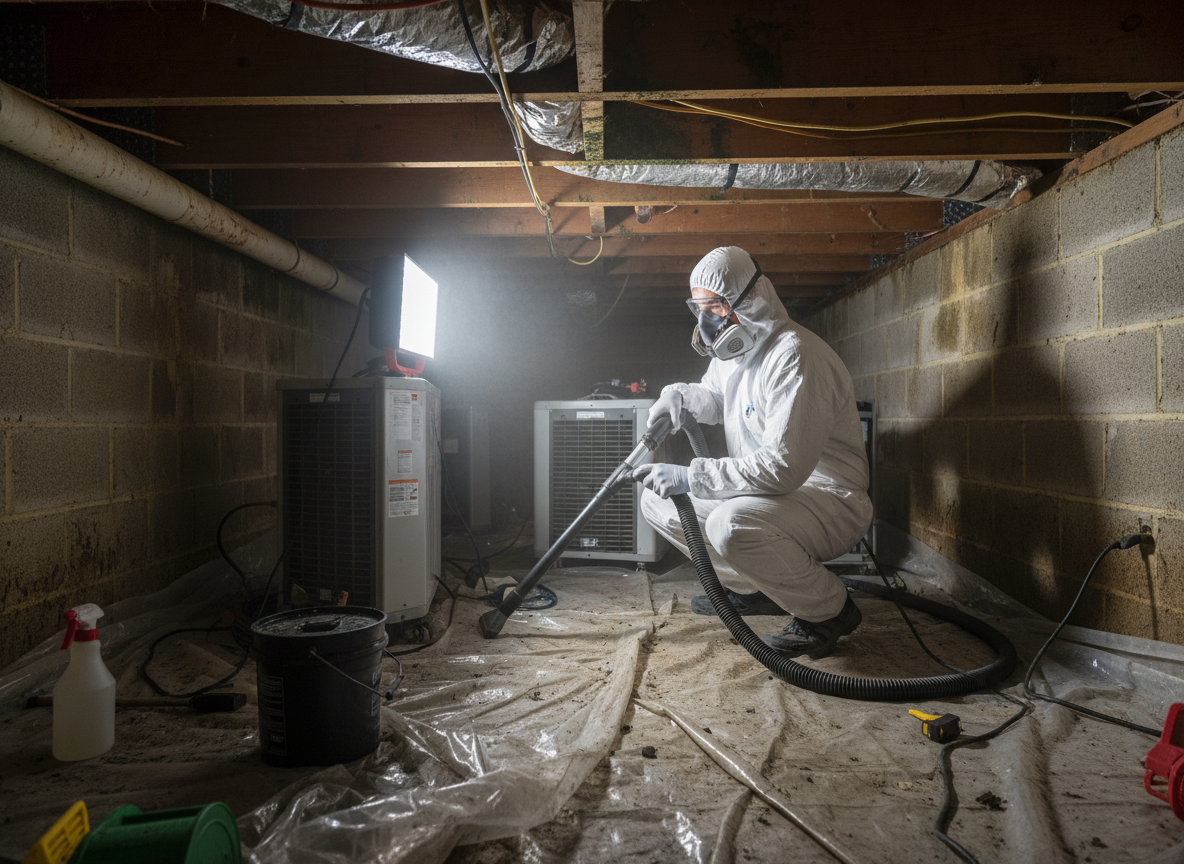
Crawl spaces in Cedar Glen homes often trap moisture from the mountain climate where warm summer days give way to freezing winter nights. This temperature swing creates condensation on joists and insulation, especially in older houses built on sloped terrain near Hook Creek and Lake Arrowhead. Without proper vapor barriers and ventilation, black mold colonies spread across soil and framing within months. Removal requires isolating the space, HEPA filtration, and antimicrobial treatment that reaches under floorboards without disturbing the living areas above.
San Bernardino County building practices in Cedar Glen frequently left crawl spaces with minimal grading and no sealed vapor barriers. When heavy rain or snowmelt runs down the San Bernardino Mountains, water pools against foundations and seeps into the crawl space. Technicians must map every low spot, remove saturated insulation, and treat exposed soil before installing new encapsulation. Skipping these steps allows mold to return the next cold snap when condensation restarts the cycle.
Access in Cedar Glen crawl spaces is often limited by low clearance and rocky terrain common around Hook Creek Road. Workers use angled entry points and portable lighting to reach corners where mold hides behind pipes and ductwork. After physical removal, negative air machines run for several hours to capture spores before any new insulation or sealing materials are installed. Homeowners are advised to keep attic and crawl vents clear of debris year-round to reduce future moisture buildup.
Technician insight
In Cedar Glen, the thing that catches most people out with crawl space mold removal is how cold winter nights pull moisture out of the ground right under older homes on sloped lots near Hook Creek. Homeowners often seal the vents thinking it helps, but that traps the condensation that feeds mold on the joists.
Condensation Mold After Winter Freeze
A Cedar Glen homeowner near Lake Arrowhead noticed musty air in the kitchen. Inspection found black mold on joists from winter condensation in the low-clearance crawl space. Crew isolated the area, removed wet insulation, treated the soil, and installed a sealed vapor barrier. The home stayed dry through the next freeze cycle.
How it works
- 1
Initial Inspection
Technicians enter the crawl space from Cedar Glen homes to assess moisture levels, mold extent, and structural exposure using moisture meters and visual checks.
- 2
Containment Setup
Plastic sheeting and negative air machines isolate the work area to prevent spores from migrating into living spaces during removal.
- 3
Mold Removal and Cleaning
Affected insulation, soil, and wood are treated or removed, followed by HEPA vacuuming and antimicrobial application on all surfaces.
- 4
Drying and Encapsulation
Dehumidifiers dry the space, then a new vapor barrier is installed over the soil and sealed to foundation walls to block future moisture.
Pricing
Cost depends on crawl space size, depth of mold, and access difficulty in Cedar Glen terrain.