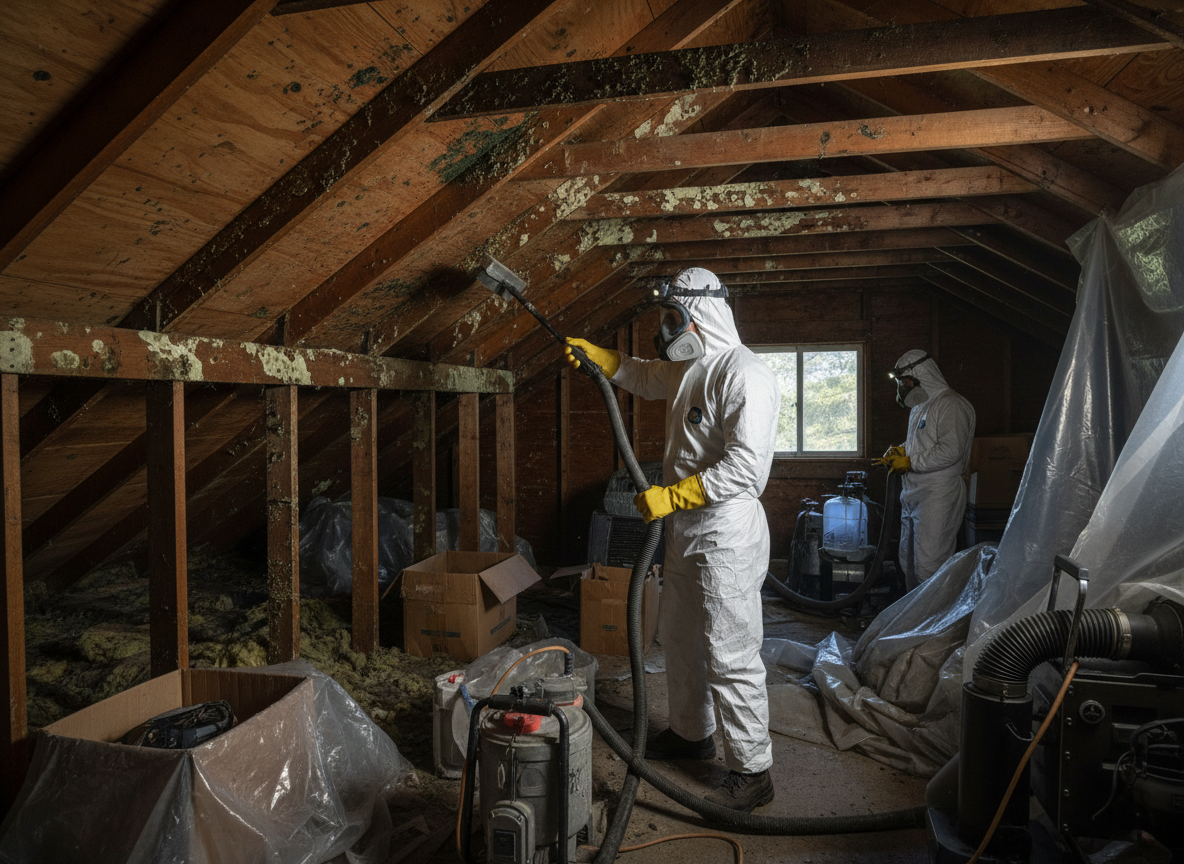
Cedar Glen sits at elevation in San Bernardino County where cold winters drive warm attic air against uninsulated roof decks, creating persistent condensation that feeds mold on rafters and sheathing. Homes built before the 1980s often lack ridge venting or have single-pane skylights that leak during heavy snow loads, letting moisture reach cellulose insulation. We start every job with moisture mapping and air sampling before any containment goes up, because disturbing dry mold in these tight attics can push spores into living spaces below.
Lake Arrowhead’s summer humidity spikes combine with winter freeze-thaw cycles to push water under flashing at plumbing vents and chimney crickets. Once mold colonizes OSB or plywood decking, removal usually requires cutting out affected sections rather than surface cleaning alone. Our crews work from the 29125 Hook Creek Rd base and carry negative-air machines sized for the steep roof pitches common here, keeping dust from drifting onto driveways shared with neighboring cabins.
Access in Cedar Glen often means working through knee-wall hatches or pulling back blown-in cellulose that has absorbed meltwater. We document every layer removed so homeowners can see exactly where the moisture path originated, usually at unsealed bathroom exhaust fans or ice-dam areas along north-facing eaves. Final clearance testing confirms spore counts have returned to outdoor baseline levels before we restore insulation and seal penetrations.
Because many Cedar Glen properties sit on sloped lots with limited equipment staging, we stage containment from inside the attic whenever possible to avoid blocking narrow roads during tourist season. This approach also limits the amount of material that must be carried down steep driveways in winter conditions.
Technician insight
In Cedar Glen the thing that catches most people out with Attic mold testing and removal is how fast condensation forms on the underside of the roof deck once the first cold snap hits. Homes built on the steeper lots near Lake Arrowhead often have north-facing eaves that stay shaded all winter, so meltwater sits under the shingles and soaks the sheathing before anyone notices a stain on the ceiling.
Hidden Growth Behind Insulation
A Cedar Glen cabin near the lake showed ceiling stains after a heavy snow melt. We found the bathroom fan venting directly into the attic, saturating cellulose along the ridge. After mapping moisture, we removed the wet insulation and a four-foot section of OSB, treated the rafters, and sealed the fan duct to outside air. Clearance samples passed and the owners restored insulation themselves.
How it works
- 1
Initial Inspection
Moisture meter readings and air sampling throughout the attic to locate active growth and hidden wet spots behind insulation.
- 2
Containment Setup
Sealed poly barriers and negative air machines isolate the attic from living areas while we work from the Hook Creek Road shop.
- 3
Removal and Cleaning
Cut out affected sheathing and rafters, HEPA vacuum surfaces, and treat remaining wood with EPA-registered antimicrobials.
- 4
Drying and Clearance
Dehumidification followed by post-remediation air testing to verify levels match outdoor baselines before insulation replacement.
Pricing
Upfront written quotes after on-site inspection; final cost depends on square footage affected and access difficulty.